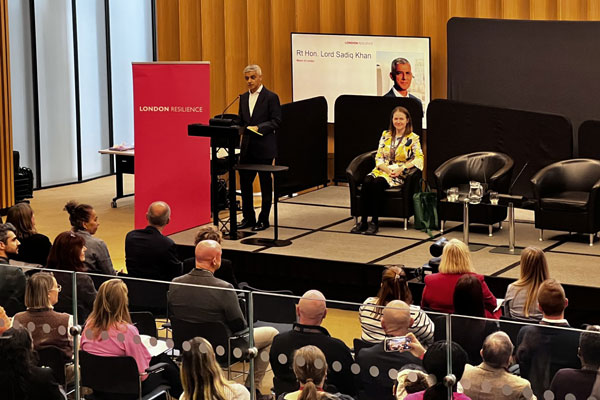
Last week’s event, ‘Protecting people and place: Strengthening workforce resilience and physical security‘, brought together representatives from business improvement districts (BIDs), MET Police and resilience professionals to explore how organisations in London can strengthen workforce resilience and enhance physical security.
Key discussion points
- Measuring and managing resilience
The Resilience Maturity Assessment (ReMA) tool was presented as a free resource developed by the United Nations Office for Disaster Risk Reduction (UNDRR) and the Corporate Chief Resilience Officers (CCRO) network, that allows organisations of all sizes to benchmark resilience across six pillars, including governance, culture and operations. It is accessible and easy to use, especially useful for SMEs without dedicated resilience teams.
- Physical security and resilience in Business Improvement Districts (BIDs)
Speakers from the New West End Company, Croydon and Knightsbridge Partnership demonstrated how physical security is delivered through coordinated, on-the-ground activity. High-visibility patrols, rapid incident response and ongoing business engagement are central to their approach.
Examples shared during the discussion showed how this works in different locations. In the West End, a large-scale, 24/7 security operation provides constant visibility and support to businesses, alongside real-time alert systems to keep members informed during incidents. In Croydon, BID Rangers act as the “eyes and ears” of the business community, providing visible patrols, responding quickly to incidents, and working closely with police to de-escalate situations and support reporting. In Knightsbridge, investment in resilience includes a major public realm transformation, with security measures such as hostile vehicle mitigation being embedded at the design stage in collaboration with the National Protective Security Authority. This is complemented by wider investment in infrastructure, including improved drainage and green space, to address environmental risks and support long-term resilience.
Across all examples, visibility, trust and consistent communication were identified as critical to maintaining business confidence and supporting effective incident response.
- Collaboration with law enforcement
Strong connections between BIDs and police are essential. BIDs act as intermediaries, sharing intelligence and responding quickly to incidents, bridging gaps between businesses and law enforcement, particularly where under-reporting of crime remains a challenge.
Accurate reporting is essential for resource allocation. This collaborative model reduces pressure on police services while improving outcomes for businesses.
- Communication and intelligence sharing
Real-time communication tools, such as alert systems, radios, and messaging platforms, play a vital role in managing incidents. Recent improvements in data sharing agreements between the Metropolitan Police and BIDs have strengthened this collaboration.
However, challenges remain around standardisation (the use of different platforms) and ensuring information can be shared consistently and securely across all partners.
- Training and workforce preparedness
Training initiatives, including conflict management and emergency response, help equip staff to handle incidents, building confidence and contributing directly to workforce resilience.
- Incident response and recovery
Effective response relies on rapid communication, visible support and post-incident reassurance. Recovery also involves listening to businesses, adapting plans, and maintaining confidence among staff and customers.
- Place, environment and perception
The quality of the public environment strongly influences perceptions of safety. Investment in infrastructure, public space, and climate resilience supports both operational continuity and long-term attractiveness of districts.
Key actions for business networks
- Encourage adoption of ReMA tool to help business members benchmark and improve resilience without requiring significant resources.
- Strengthen collaboration between businesses, police and local authorities.
- Work towards interoperable communication systems that enable real-time information sharing while addressing data protection concerns.
- Provide access to training programmes and resources that enhance workforce preparedness across member organisations.
- Advocate for shared investment in safety and infrastructure.
Key actions for businesses
- Use internal metrics such as absenteeism, turnover, and commute patterns to assess and monitor workforce resilience.
- Engage actively with BIDs
- Implement training and protocols that enable staff to respond effectively to a range of incidents.
- Ensure access to reliable channels for receiving and sharing real-time information during disruptions.
- Focus on staff confidence and support during disruptions.
The discussion highlighted that the resilience of people and places is rooted in practical, day-to-day actions: maintaining a visible presence, fostering strong collaboration between businesses, BIDs and the police, and ensuring clear, timely communication.
Using simple tools such as ReMA, alongside existing internal data (for example workforce indicators like turnover and absenteeism), enables organisations to take meaningful first steps, while training and ongoing engagement help build staff confidence. Ultimately, resilience is everyone’s responsibility.
With many thanks to all the speakers:
- Jamie Conroy, Director of Security & Operations, New West End Company
- Rebecca Handley, Director of Place and Environment, Knightsbridge Partnership and King’s Road Partnership
- James Martin, Acting Inspector, Met Police
- Stephen Parkinson, Group Director of Safety, Security & Resilience, Sky
- Matthew Sims, Chief Executive, Croydon Business Improvement District