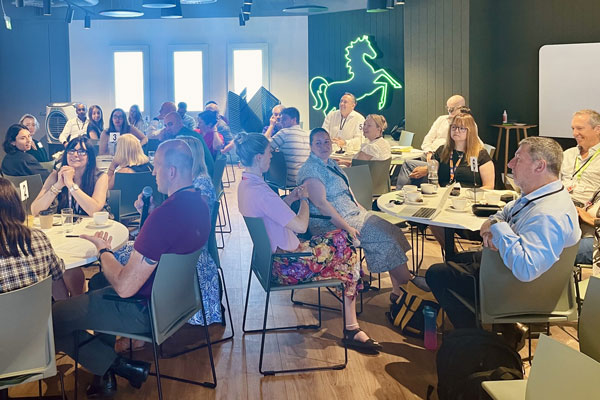
Leading in the Age of Intelligent Resilience | Breakfast roundtable, Vintry & Mercer Hotel, London
On 10 September 2026, Resilience First, in collaboration with Everbridge, convened a roundtable in London to address a question of growing strategic importance: how are organisations across sectors applying AI to their resilience practices, and what challenges could emerge from its deployment? Bringing together practitioners from across consultancy, intelligence, resilience, technology and transport, the session examined the evolving relationship between people and AI, its practical applications in operational resilience, and the leadership, governance and trust required to realise its potential. The result was a thoughtful discussion that unpacked where AI is already adding value, where caution is needed and what leadership must bring to ensure it strengthens rather than undermines resilience.
Redefining Human-AI Synergy in Resilience
The session opened by considering the role of people as AI becomes more embedded in resilience. However quickly technology advances, it always comes back to the individual. Operating environments have become increasingly complex and expectations ever more demanding, yet traditional resilience models assumed that individuals would execute complex plans flawlessly under pressure. AI shifts this paradigm by providing context, evaluating potential impacts and recommending actions in real time.
Integrating AI in this way accelerates decision-making and helps prevent “decision freeze” at critical moments. However, it was emphasised that machine capability must be balanced with human critical thinking and independent judgement, and that accountability for decisions must remain with people. Resilience was likened to a relay race, in which success depends heavily on the quality of handovers between people, teams and systems. AI has the potential to reduce the information and context lost at these points, strengthening the continuity on which effective response depends.
Practical AI Applications in Organisational Resilience
Participants described a growing range of practical applications. Internal AI agents are supporting non-specialists with the fundamentals of business continuity planning, risk assessment and ongoing feedback, improving the quality of plans and enabling small teams to achieve more with limited resources. AI is also being used to analyse disparate datasets and documentation, supporting horizon scanning, triage, trend analysis and gap identification.
AI is also enabling more dynamic and sophisticated exercising and stress testing while significantly reducing resource requirements. More advanced approaches include creating digital twins of organisations and deploying AI agents to test them from multiple angles, while AI’s capacity to map dependencies helps reveal how a single variable can cascade across a system. Participants stressed, however, that such data must be clean and verified in advance, as there is no time for validation once a crisis is under way.
Leadership, Governance and “Intelligence versus Wisdom”
Board and executive appetite to mandate AI is high, yet it was shared that leadership often lacks clarity on its practical resilience applications beyond basic co-pilot tools. A significant risk arises when leaders confuse polished outputs with genuinely high-quality strategy. AI may provide intelligence, but it lacks experience, and senior leadership must therefore supply the layer of wisdom needed to validate it. Participants also noted that AI training and system maintenance require dedicated resources, creating a tension between short-term time savings and the demands of long-term governance.
Sovereignty, Barriers and Trust
Data security and operational sovereignty were raised as concerns. Organisations are increasingly turning to internal large language models and controlled agent-to-agent architectures to prevent sensitive crisis data from entering public ecosystems. The prevailing view was that the appropriate model depends on the intended outcome, and that remaining model-agnostic is a prudent approach.
Adoption is further shaped by cultural and legal factors. Attitudes vary considerably across regional markets, bureaucracy continues to slow progress in the public sector, and legal teams remain cautious about the use of AI during live crisis response. A persistent disconnect between technical capabilities and operational resilience needs compounds these challenges. This is exacerbated by digital literacy gaps across both returning and incoming workforces, alongside concern that over-reliance on AI could gradually erode critical thinking and subject-matter expertise.
Looking Ahead
The roundtable concluded with a broader question: what outcomes should organisations seek from AI? Participants agreed that adoption should be driven by outcomes, whether by reducing the burden of repetitive work, freeing capacity for higher-value activity or enabling people to perform their roles more effectively. The next step for many organisations is to move from experimentation to proven resilience use cases that justify investment, and to ensure that governance, skills and organisational readiness keep pace with ambition.