What connects a supermarket trying to keep food fresh, a family struggling to sleep at night and a business trying to keep its workforce operational and productive?
More than we might think.
Different challenges, but a common reality: businesses and communities are more connected than we often realise, and their ability to withstand disruption (in this case, extreme heat) depends on one another.
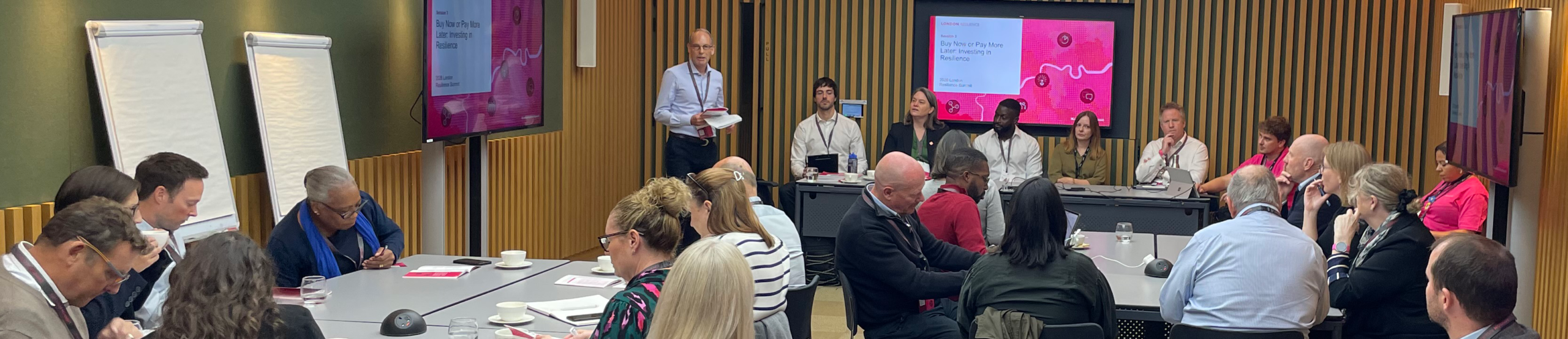
This was a central discussion point of the Investing in Resilience session at the London Resilience Summit hosted by the London Resilience Unit at City Hall. The Mayor of London, Rt Hon. Lord Sadiq Khan, opened the Summit setting the scene for discussions on how we can build a more resilient London.
The business case is changing
Resilience is often seen as a cost: something organisations invest in to prepare for what might go wrong.
But the discussion highlighted a different perspective. For businesses delivering critical services and infrastructure, demonstrating resilience can be a competitive advantage. The ability to maintain services during disruption can help distinguish an organisation in the marketplace.
An example came from Tesco, whose representative described investments in refrigeration to reduce food waste, alongside exercises to prepare senior leadership for severe heatwaves.
This illustrates how investing in resilience can deliver both operational and commercial benefits.
The social infrastructure
While individual organisations often bear the cost of investing in resilience, the benefits can extend across entire communities.
Businesses depend on their local communities for employees and customers. If households and neighbourhoods struggle during disruption, businesses feel the consequences too.
This prompted an important challenge from an audience member representing a community climate organisation in Islington: businesses may want to support local communities financially, but have they actually built relationships with them?
Building those relationships, however, is not always straightforward.
Large national businesses cannot realistically engage individually with every local authority or resilience forum. Equally, local organisations need the resources and capacity to establish and sustain partnerships. As the discussion emphasised, building this social infrastructure takes time, people and investment.
So where should the money go?
When asked to prioritise investment, both panellists and audience members highlighted community capabilities, critical infrastructure and climate adaptation.
Extreme heat was a particular concern, with impacts on housing, transport, working conditions and everyday life.
The importance of understanding dependencies between essential systems, including power, water and transport, was also reinforced.
Making resilience a longer-term priority
With competing pressures from AI, cyber threats, climate change and geopolitics, leaders face difficult investment choices, often within relatively short decision-making horizons.
The discussion pointed to the importance of bringing resilience closer to board-level decisions and making the case not only through risks, but through the opportunities it creates.
Resilience benefits everyone, but how can we ensure that responsibility for investing in it is shared? Businesses, communities and policymakers should keep addressing this question.
With special thanks to the panel, chaired by Rick Cudworth, Executive Director of Resilience First.
- Jonathan Ammoun, Senior Policy and Programme Officer, Climate Change Adaptation, Greater London Authority
- Neil Bourke, Partner, Reputation, Crisis & Resilience, Deloitte
- Janette Browne, Deputy Director, London Resilience Unit, , Greater London Authority
- Ola Jacob, London Market Business Development Director, Global Parametrics
- Kate Levick, Deputy Executive Director and Distinguished Policy Fellow (Earth Capital Nexus), LSE