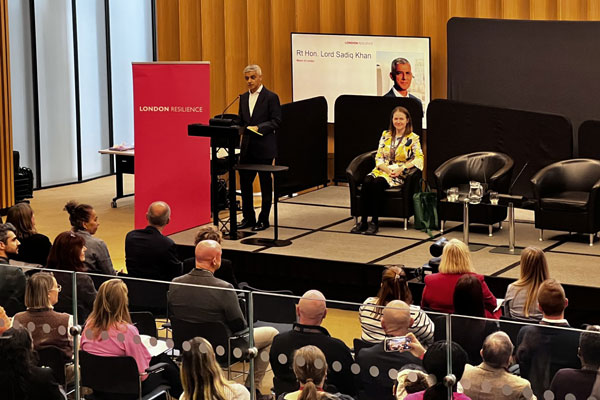
On 2 June 2026, Resilience First convened a roundtable at the Nature & Climate House during the London SXSW 2026 festival to address a critical and timely question: as climate impacts intensify, how resilient are our organisations? Bringing together senior representatives from across the insurance, finance, transport, health and telecommunications sectors, the session explored the current state of organisational resilience to climate change, the barriers to accelerating action and what cross-sector collaboration will require to address climate resilience challenges.
The roundtable was chaired by a Resilience First member, Elisa Seith, Director of Climate Risk and Financial Services at Jupiter Intelligence, opened by Richard Threlfall, Senior Adviser at Resilience First, and facilitated by Bellwether Group. The result was a candid exchange across several themes, revealing the progress underway, gaps that remain and ideas to close those gaps.
Preparedness is improving but uneven
Participants reflected on the state of climate resilience within their own organisations and sectors. The overall picture was one of genuine progress, with climate resilience increasingly being integrated into core business strategy, supported by growing risk intelligence capabilities and established crisis management systems. Yet, it was made known that preparedness remains uneven, with significant gaps persisting in asset resilience, infrastructure planning and long-term scenario analysis. Key challenges identified included the availability and quality of data for scenario planning, the complexity of interdependencies across sectors and regulatory and policy gaps that constrain coordinated action.
Understanding interdependencies
One of themes that emerged was the need to systematically map and address interdependencies between sectors. Cascading risks, where a failure in one system triggers disruption across others, represent one of the most pressing dimensions of climate vulnerability.
A compelling case was made for moving beyond a hazard-by-hazard approach, arguing instead that organisations should focus on end-user impacts and adopt a common consequence framework to identify where vulnerabilities converge across systems. It was noted that current efforts to map these interdependencies remain fragmented and inconsistent, and there is no unified or widely accessible framework to support cross-sector coordination.
Making the case for resilience investment
It was agreed that despite growing awareness, investment in climate resilience continues to lag. The discussion surfaced the familiar but persistent challenge that most capital still flows toward mitigation rather than adaptation, driven by short-term incentive structures and decision-making frameworks that fail to adequately capture the long-term value of resilience.
Participants emphasised that resilience must be positioned as a financial priority, and that investment decisions are ultimately driven by CFOs, making it essential to translate the climate resilience agenda into the language of financial risk and opportunity. This means demonstrating the cost of inaction, quantifying externalities such as environmental and social impacts and aligning incentives to support longer-term planning.
Drivers for action
Running through the entire discussion was a recognition that how we communicate climate resilience is as important as what we communicate, and that technical data must be clearly contextualised in terms of real-world and business impacts to resonate with decision-makers.
Of all the drivers of action discussed, the impact on human health emerged as perhaps the most powerful catalyst. One participant highlighted that tropical diseases are moving closer to home, and the effects of heatwaves on population health, safety and productivity are increasingly difficult to ignore. Framing climate resilience in terms of duty of care to their employees, alongside measurable economic outcomes, offers a route to engaging decision-makers across organisations.
Data gaps and barriers
Across the discussion, data emerged as both a key enabler and a constraint. Gaps in data availability, particularly for quantifying physical climate risks, are limiting organisations’ ability to model scenarios and make informed decisions. Meanwhile, much of the scientific data that could inform business action has existed for years but is not being communicated in ways that are practical or accessible to organisations.
Confidentiality concerns were also raised as a barrier to the exchange of information both within and across industries, highlighting the need for improved data sharing mechanisms, a prerequisite for the kind of cross-sector collaboration the discussion repeatedly called for.
Cross-sector coordination
Participants were united in recognising that climate resilience cannot be achieved in isolation. The interdependencies between sectors mean that progress made in one area can be rapidly undermined by vulnerabilities in another. Yet collaboration, where it exists, remains fragmented and inconsistent.
Key gaps were identified: a lack of centralised coordination or oversight, limited visibility of activities across regions and sectors, and weak integration between local and national resilience planning. The group agreed on the need to “connect the dots”, to embed resilience into policy cycles, asset planning and system design in a way that is coherent and accessible between sectors and geographies.
Looking ahead: next steps and continued engagement
The roundtable closed with a sense of shared purpose and support for continued engagement, making clear that the will to work across boundaries, share data and align on common frameworks is growing. Participants agreed that greater visibility, deeper collaboration and a concerted effort to address the blind spots identified will be essential to making meaningful progress.
Resilience First will build on the insights from this discussion by convening further cross-sector engagement and working with members and partners to develop practical outcomes. If you are interested in contributing to this work and helping to strengthen climate resilience across sectors, please get in touch at contact@resiliencefirst.co.uk.