Reflections from the ‘Not Business as Usual’ wargame
A prolonged power outage or a shortage of essential supplies can affect far more than one company’s operations, with consequences for employees, customers and local communities. For business leaders, building resilience is a strategic choice; one that underpins long-term performance.
At Resilience First, we help businesses strengthen their resilience through a whole-system and whole-of-society approach. Our working groups, expert discussions and resources connect organisations across sectors, helping members learn from one another and bring business experience into discussions with government.
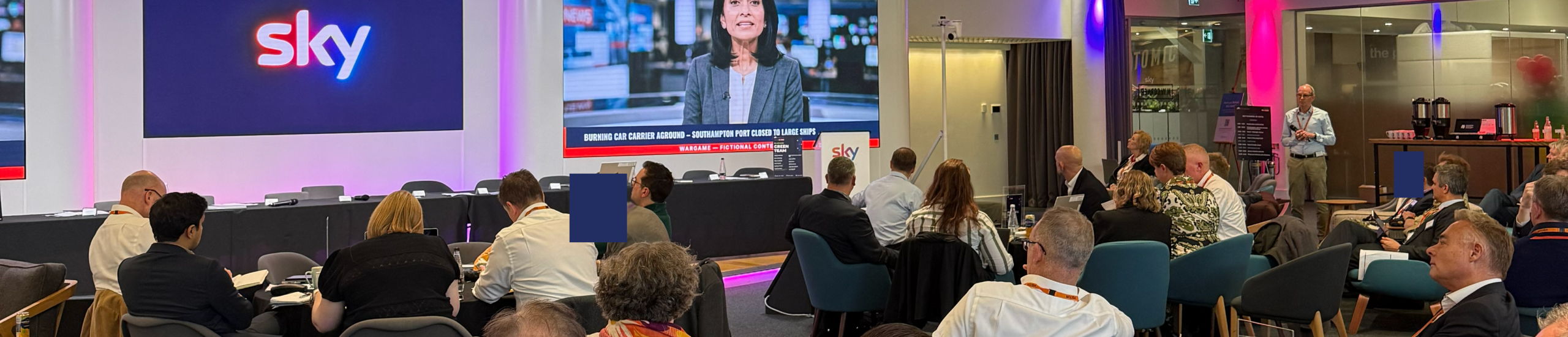
That approach shaped our Wargame: Not Business as Usual, hosted by Sky on 23 October 2026 with support from Sky News. Following keynote remarks from Deborah Haynes, Defence and Security Editor at Sky News and Creator of the Wargame podcast, participants from over 30 of the UK’s leading businesses stepped into executive roles at fictional companies critical to automotive, defence and food supply in the UK. Watch Sky News’s video from the event.
During the exercise, teams selected investments and balanced trade-offs within limited budgets before facing a series of simulated incidents. The scenario reflected threats in the ‘world as it is today ‘, reflecting a hostile state seeking to undermine the economic base and societal cohesion of the UK. Throughout, external stakeholders challenged teams’ decisions and demanded answers. Discussions were held under the Chatham House Rule.
The Wargame highlighted several lessons that can inform how leaders approach resilience in their own organisations.
- Strategic choices involve difficult trade-offs. Choosing wisely created strong foundations for an organisation’s resilience and longer-term performance.
- The benefits need to be clearly articulated. Participants prepared analyst briefs to explain the rationale for their choices and the expected effects on organisational performance in the short and longer term.
- Resilience takes time to build, and time is not on our side. Some investment options in the exercise would take several years to implement. Participants explored opportunities to accelerate delivery and faced the challenge of managing disruption while measures were still being put in place.
- Critical dependencies extend well beyond an organisation’s control. A port closure interrupted production far inland, while an incident at a neighbouring site prevented staff from reaching work. The Wargame illustrated businesses’ reliance on infrastructure and supplies, as well as how disruption within one organisation can affect others.
- Misleading information can shape judgement. Leaders needed to question the information they saw and explain the reasoning behind their decisions to wider stakeholders. Teams made decisions amid uncertainty about what would happen next.
- Resilience requires the ability to absorb disruption and adapt. Organisations are used to preparing for familiar, often relatively manageable threats. The risk picture today is very different. Organisations need to prepare for widespread and prolonged disruption, including multiple events occurring at once. Planning should bring together the ability to absorb disruption, adapt operations and recover, while recognising dependencies beyond an organisation’s direct control.
- Sharing knowledge and building relationships are key to strengthening national resilience. Participants discussed the need for closer cooperation between business and government, including local authorities and Local Resilience Forums. Businesses can contribute by sharing their expertise and being clear about what they can do and the support they need from government and other partners.
This focus on strengthening organisational resilience is central to our wider programmes. Our Model for Organisational Resilience, developed with Cranfield University School of Management, supports a more systematic approach to understanding and measuring resilience.
The event followed the launch of the government’s Be Ready campaign on 22 October. The campaign encourages households to prepare for emergencies affecting everyday services, including power, water and communications. Its guidance includes preparing for three days of disruption where possible and checking eligibility for additional support through the Priority Services Register.
Household and business resilience are closely connected. Employees and local businesses are part of communities that may be affected by the same incident. A whole-of-society approach means recognising those connections and understanding how businesses, public bodies and communities can support one another.
We thank Sky for hosting us, Deborah Haynes for setting the scene and reporting on the event, and everyone who contributed their experience and ideas. We look forward to continuing these conversations with our members and partners.
Businesses interested in joining our network can enquire here about opportunities to apply the Model for Organisational Resilience, benefit from interorganisational learning and share expertise.
If you are a critical national infrastructure operator or essential services provider, you can also join our National Exchange for Sustaining Critical Infrastructure Services (NEXSCIS) programme, which has the support of the Cabinet Office. The programme underpins our wider aim of strengthening resilience across these vital sectors and society. Be part of this important cross-sector community by joining NEXSCIS. Member and Founder Member places are still available.